Lau Schulpen of CIDIN at the Radboud University in Nijmegen researched the effectiveness of Dutch “private initiatives” working in international development. Last week, his first findings were published, and created a little storm in the Dutch development sector (see e.g. the Dutch Trouw newspaper, copied by most other papers). I’m just returning from a presentation of his results, followed by a debate with Henny Helmich of NCDO, and Robert Wiggers of Wilde Ganzen: two organisations who fund a lot actvities of private initiatives. My take-away: private initiatives need a branch organisation, a kind of union.

Schulpen did a qualitative research, starting with an address list of 257 private initiatives, narrowing it down to interviews with 35 of them, and visiting 28 field projects in Ghana and Malawi. Of those, he qualified 24 as “brick & mortar” projects (like building, handing out materials, paying for certain things), and 4 as “complex” (like micro credits, educational programmes). Schulpen concluded that many projects do not deliver sustainable results, due to a couple of main reasons:
- There often is (too) little attention for capacity building, often taking one of these forms:
- Working with local individuals rather than organisations, sometimes even harmful
- Having a mirror organisation of family or friends, with not enough self-reflection or patronising local capacity
- Working with a whole village or community, resulting in unclear responsibilities and relations
- Working with volunteers and no budget, and not investing money
- Many work in splendid isolation, not benefiting from learning opportunities
- Almost no monitoring & evaluation, and no full accountability of activities and spending.
The panellists mainly concluded that the donor organisations who fund private initiatives should align their policies more, have stricter requirements before funding, work together on that, and support more collaboration and learning events for their grantees.
When finally some of the people of private initiatives in the audience got a chance to say something too, their reactions were somewhat to be predicted:
- Don’t talk about us, talk with us.
- Stop talking as if we are not professionals.
- Acknowledge our strengths and work with us.
The funders ask you to comply with requirements before you get training and support as part of a grant. The definition of “private initiative” seemed to narrow down to those who apply for funding with them. Take away the money, and the service of the funder looks bleak. Its value mainly defined by the grant.
The private initiatives would benefit from being organised in a way where their interests are leading:
- Connect with each other, and learn from each other based on their needs
- Offer their skills and expertise to the big NGOs, and get proper support when needed
This was exactly the kind of input I was hoping for: tomorrow I’m meeting again with people from many COS centres. They actually work with a lot of these private initiatives to support them in their work. We’ll discuss next steps for the Dutch World Atlas, a platform helping you find such an initiative near you to join (well, if you’re in The Netherlands…), and this fits nicely in distilling a service offer for that platform.
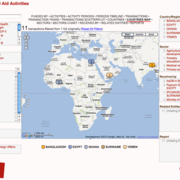 Earlier this year, I was approached by Michiel Kuijper, who was working on his Bachelor degree at the Amsterdam University of Applied Sciences, and was looking for a project to combine Business Intelligence and text mining. Together, we started exploring how to apply this in the development aid sector.
 Klooster Dolphia (photo by