Around the web in week 47, 2011
Fundstücke published this week:
- Paul Kilelu — Fighting for a Noble Cause 21 Nov 2011, pelle By Halima Tahirkheli Nabuur is pleased to introduce you to Paul Kilelu, the local representative of …
Fundstücke published this week:
Owen Barder published an overview by the International Aid Transparency Initiative (IATI) on how far countries and donors are on their road map to publish their aid spending data before the High Level Meeting in Busan, end of this month.
If you’re curious about how the International Aid Transparency Initiative (IATI) can help aid effectiveness, have a look at their video with some stakeholders:
The International Aid Transparency Initiative (IATI) from Development Initiatives on Vimeo.
One of the side-events of the Open Government Data Camp, last week, was an Organisational Identifiers Workshop put together by Tim Davies and Chris Taggart. The meeting discussed the various challenges in linking information about organisations held in separate data sets. Although participants were careful to avoid the word “ ontology “, one of the break-out groups did look at describing relations between organisations. Since I graduated on research into “part-of” relations in an ontology, and what you can infer from them, I joined that discussion. Here’s what we came up with.

The workshop was a good chance to catch up with where things are right now, with several organisations at the table and participating online that have to deal with information about organisations:
How to create identifiers for organisations across the world, which might not be registered anywhere, and which relate to each other and to more generic concepts, in such a way that we can capture all the meaningful relations and data we want to capture?
How to make sure it works with the schemas already in use in big organisations? And that it works with data stores that are not open? Without introducing another naming authority?
We split up in a couple of groups, one looking at identifying public bodies, another at the technical architecture that might be needed, and a third at common terms to describe relations between organisational entities. I joined that third group.
We spent some time discussing various types of relations, and I also looked around to find possible candidate schemes, but without much luck. I couldn’t find an obvious example, like the FOAF standard for personal relations. A few standards, like OrgPedia, or the Organizational Ontology, seem likely candidates, but don’t cover this area (yet?).
We looked at some use cases:
We acknowledged additional cases, like finding influential relations between corporate or organisational entities based on board membership or roles of individuals, but decided not to take that on in this discussion.
We came up with a first-version typology of relations. The naming and exact semantics will need further review.
These are relations between entities that have a “permanent” and “structural” character. Of course, all these relations are bound in time, but the beginning and end points may not be known.
We distinguished two sub categories.
(This typology still fails to capture something like a brand as abstract entity.)
These are relations that express a change in the structure or responsibilities of some entities, often the beginning or the end of particular entities. We identified four basic types:
More work is needed to mold this into a useful standard (relations are currently described from the perspective of one end, there is still plenty of room for interpretation, things have not been tested on real-life examples described as use cases, and so on).
And, of course, we’d need those organisational identifiers to refer to other entities, and find ways to delegate resolving identifiers to services that can provide additional information on those identities. See the whole report of the workshop on the OGDCamp wiki for the results in the other discussions as well.
But thinking about and discussing relations between those entities brought back memories of all the fun in making machines infer and report unknown relations 🙂

![]()
The current discussion around open data often boils down to releasing data sets, and seeing nice visualisations and apps. But lets not forget that the full phrase is linked open data. The real power comes from linking the data. This week, the Open Government Data Camp in Warsaw lets us explore this more.
Just as web pages today link to other pages for further information, the data sets of tomorrow will link to other data sets, for more data. Your browser will help you navigate the data space.
The BBC is ahead in this game, and working on a “Digitial Public Space” project, linking together many sources of cultural data. Jake Berger writes on the BBC blog:
Early versions of this data model indicate that – as hoped – there will be many, varied and often unexpected journeys that can be made through these catalogues and the material they describe. For example, a user starting out by watching a film of a production of Macbeth from the Royal Opera House might then look at a scan of a rare musical manuscript from The National Archives, then browse similar manuscript scans held at the British Library, watch a clip from a BBC documentary about how paper was produced in Shakespeare’s era, before ending up learning about the plants used to make the paper using information from The Royal Botanic Gardens At Kew. In a [Digital Public Space], all of this could happen in the same online space.
That may still sound a bit like the current web of pages. Except: the publishers only provide standardised links for “Shakespeare”, “paper”, etcetera, and your browser makes the connections to offer you ways to move forward:
Mo blogged about the development of a web browser-based user interface, which navigates through these catalogues using the concepts of “people”, “places”, “events”, “things” and “collections”.
In international development aid, the IATI standard is an effort to work towards a similar “digital public space” in which you can navigate through “organisations”, “activities” and “results”.
An important part of establishing that space is to work towards joint standardised identifiers. At our ODDC conference in May, David Pidsley’s Virtual Workshop on Linking Development Data was focused on that, and next weekend, Tim Davies is organising an Organisation Identifiers Workshop as a fringe event for the Open Government Data Camp, in Warsaw, to continue working on this. And we’ll have more general Open Data for Development: Open Space session on Saturday morning.
Fundstücke published this week:
We've participated in two interesting events in the last two weeks: the Open Aid Data Conference in Berlin, and the IATI in the Visigrad countries conference in Prague. A proper post is still due, but here's already a video of the closing talk from Transparency International's founder Peter Eigen, "Overcoming the fear of transparency":
[openaiddata.de] Peter Eigen – Overcoming the fear of transparency from Open Knowledge Foundation on Vimeo.
Today, Ben Knapen, the Dutch State Secretary for development cooperation, presented the “Resultatenrapportage”, the “reporting of results” on Dutch efforts in development aid in the period 2009-2010. He used the occassion to also present the first release of Dutch government data in the IATI standard format, making The Netherlands the fifth signatory to deliver on its commitment for phase 1 of the IATI agreement.
The “Resultatenrapportage” report itself is the result of the collaboration of some two hundred writers from government and NGOs, in a process led by the Ministry of Foreign Affairs and Partos, the Dutch platform of organisations in development cooperation.
To make the report a stepping stone towards sharing more data online, it is no longer being printed, but instead made available as PDF document, with links to offer easy access to background documents and data.
At the same time, the State Secretary announced the opening of http://www.minbuza.nl/opendata with the first set of spending data released, up to date to the end of the second quarter of 2011.
Behind the scenes, the last bits are put in place to automatically register the data at the IATI registry. The data will be udpated quarterly, so the next release is expected to already happen in early October.
It will be interesting to see how the regular publication of the data leads to continuous improvement of the data: less jargon, less abbreviations, clearer descriptions.
In addition to the IATI data, there also is a set of documents of embessies, reporting on the progress of particular projects in countries around the world. An open challenge is to now find ways to link the information in these documents to the data available in IATI.
Knapen expects civil society to also publish their data in IATI, so that it becomes easier to look directly into the operations and processes happening at the core of international development cooperation.
The Guardian has made a website to slice and dice the data of the World Bank, DFID, etc. In collaboration with Akvo, the Ministry is doing a pilot project to show their water project portfolio, but Knapen hopes that parties in The Netherlands will also explore the expanding universe of data to answer their own questions and develop their own perspective on what is happening.
After offering the report on a (symbolic) USB stick to Nebahat Albayrak of the Parliamentary committee for foreign affairs, she said she hopes the open data will make the political debates more informed and perhaps even a bit more objective, but also stressed the importance of reflecting on actual impacts as done in the “Resultatenrapportage”.
Albayrak also hopes to also evaluate the “resultatenrapportage” and the “open data” initiatives and standards from the perspective of effectiveness for their work in the “kamercommissie”.
At “Open Data for Development Camp” in Amsterdam, Marijn Rijken of the Dutch research institute TNO presented on “open data opportunities in development”. Together, we’re now drafting a research proposal to gather answers on pertinent questions around open data in development: “What are the social, organizational, technological, financial and legal effects of open development?”. It’s part of our efforts to build network as the basis for a Dutch knowledge platform.

TNO has done similar sector-wide research around open data in other sectors, and would like to take the existing research in this area a step forward. AidInfo published a cost-benefit analysis on open data, and a framework for this. The Transparency and Accountability Initiative recently published a report on introducing open data in middle income and developing countries. And we also like to include “effective use” and impacts on e.g. privacy and security, and a possible “data divide”.
We plan to look at existing literature and research, sketch a vision on what “open development in 2020” could look like, and provide a framework for a social cost-benefit analysis, and the ground work for a road map to help organisations embrace open data and “do it right” (e.g. critical success factors, activating crucial stakeholders and infomediaries).
Of course we like to hear of other research projects with recent publications or currently underway.
Aid Transparency Barcamp Nepal, run jointly by YoungInnovationPvt. Ltd and aidinfo, is a conference to raise the awareness of the foreign aid scenario in Nepal. It intends to create a platform to initiate conversations and connections on the effective use of ICTs to support aid transparency and effectiveness. There will be a chance for organisations and individuals to showcase innovative ideas and tools that promote effective accessibility and visualization of aid data. Further, it is hoped that it will create a platform where the best technology products around aid data can be collaborate, supported, sponsored and promoted. It is also an opportunity to raise awareness of the International Aid Transparency Initiative’s (IATI) standard for publishing aid data.
Featured speakers will include Bibek Raj Kandel, Simon Parrish, Anjesh Tuladhar, Aman Shakya, Bibhusan Bista, Hemanta Sapkota, and Prabhas Pokharel. Sessions will include:
This event is targeted at the tech community (programmers, app developers, FOSS enthusiasts, mobile developers), INGOs, aid donor communities, government officials, the media and aid transparency professionals and practitioners.
For more information on this event, please visit the website: http://nepalaid.yipl.com.np/

BoF “Open data in development” at OKCon (via Tobias Eigen)
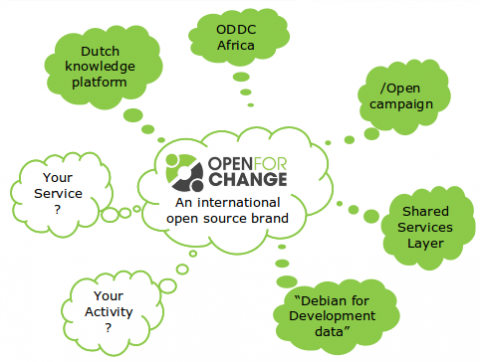
But what did we learn from open source? Two days of Open Knowledge Conference gave lots of food for thought. And lots of inspiration as well: plenty of projects doing interesting work, and experiences to share. And to add a cherry to the cake, we had a great “open lunch for development” with several people active in development aid. My (delayed) take-aways for Open for Change.
Nigel Shadbolt and Andrew Stott shared their lessons from setting up data.gov.uk, and Tom Lee talked about data.gov and the recent threats of its budget cuts.
It’s crucial to have top-down support, bottom-up activists, and middle-tier connectors, to bring everything together.
There are many reasons to embrace open data, don’t rely on a single one to make your case: tranparency and accountability; economic value, growth and innovation; efficiency and cost-effectiveness; improving (public) services; (public) engagement; and civil society and social capital.
Close the feedback loop: the “build it and they will come” approach won’t work here either. Try to publish data that matters to people, but also consider that “data probably has a long tail”.
Statutory requirements matter.For governments, this mainly has to do with legal frameworks and obligations. But every organisation could (and should) enshrine crucial elements of open data in their policies: how to ensure “open” stays open, and how to prioritise.
In open data, a lot can be learned from “open source”. In terms of tools and practices, I think we are, but in terms of the stories we tell ourselves and others about why we do it, Benjamin Mako Hill gave some interesting insights on the promise of open source to create better software because more people will be able to see, comment on, and improve the code.
In reality, this hardly happens. He showed graphs of projects on Sourceforge, the first major hub of open source software. The median number of developers working on a project is one. If you only look at “mature projects” (multiple releases, longer history), the median is still one. If you look at the most popular projects (10% of most downloaded), the median is two.
In other words: there are very, very few projects where mass collaboration did happen.
And we actually don’t really understand why some of them succeed.
It doesn’t mean we should not do open source, but we should not promote it with the story that it leads to peer review and better code. There are plenty of other reasons, though, and we should make sure we capture those in our Open for Change Manifesto as well:
In our beta Manifesto, we tried to capture the essence of why we want to be open, and OKCon was a chance to reflect on it.
I liked a definition given by Jose Alonso of the Web Foundation: the web is humanity connected through technology. And as Brewster Kahle of archive.org said: the last generation put a man on the moon. Pretty cool, but our generation can make all knowledge available to all people on earth, for always and for free. That’s a powerful ambition too.
It is crucial to also translate the promise of open data, open access and open knowledge to “effective use”: how do we make sure we create autonomy, control and empowerment, but more even so: security for the ones who want to realise their “ right to access”? “Open” is part of a struggle for human rights.
Hopefully, a joint “Slash Open” campaign can unite the efforts of many organisations working for humanity in shaping the technology we need and put it to effective use.