Skip to content

Updates

Moving to Ubuntu

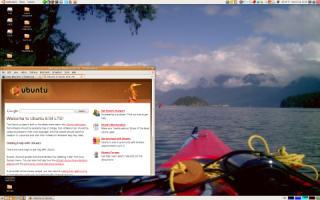
I’ve finally made to switch: my desktop now is open source! I’ve pushed back for quite some time, had too many programs that still required Windows, and generally just wasn’t ready. But now I did it. My laptop needed a fresh install, and I tried out the latest Ubuntu (going under names like 8.04 and Hardy and Hardy Heron). And decided to stay with it, after trying out things for several weeks. Why?

moving-ubuntu.png

My Ubuntu desktop

  • Windows XP was running smoothly, but I found myself duplicating efforts on figuring out how to do things on Windows, when I just did them on a Linux server, to have a good local development environment. And I had already switched to mostly open source software for my day-to-day work.
  • Linux is catching up with the usability thing. The latest Ubuntu managed to present a desktop that didn’t feel like falling back into the last century, and it recognised most hardware. Particularly, I now could get my wireless working without a lot of effort, something I didn’t manage 2 years ago.
  • I’ve been able to find reasonable alternatives for almost all software I used. Sometimes it is a bit half-baked, but then again, it covers the 80% of the cases I use it for, and at least I can do my work the way I did, most of the time. Installation and removal of “supported packages” definitely is easier. And a lot of software is more “hackable” (example in a next post).
  • VirtualBox is like the VMware I had (but now it’s free), and it allows me to run a Windows XP virtual PC inside my Ubuntu desktop. Sadly, though, it fails on the only thing I really need: reporting my invoices and expense declarations…

There’s still stuff to be desired, too:

  • Most of the special features of my laptop seem to be unavailable, even though it’s not really the latest model. It is a Sony, with several Intel components, where Intel is supposed to be reasonably open source friendly. But the LED light for the wireless doesn’t work, and I can’t do dual screen (on the other hand, I can do 1920×1200 resolution on my external screen, which wasn’t possible under Windows)
  • I easily find myself searching the interwebs for solutions, with information from 2006 or even 2007 that seems to be completely irrelevant to my version, and lots of software that is hardly documented at all. A lot would be more or less “impossible” without knowing quite a bit of the technology under the hood, and ample time to research and hack away.

Meeting “my project” and the N2Y3 community IRL

NetSquared already has started. Sitting next to again an impressive cake, the room is buzzing while I write my intro. Rolf Kleef, from Amsterdam, here to enjoy San Francisco for some three weeks, and doing the last little bits with Roshani and Mike of Oneworld US to be ready for two rollercoaster days!

We're about ready to get the massive content of Oneworld to social networks and different devices, launching the new Drupal-based site any moment now as the platform for it. I've already written about the first work we did to get ready for the Mashup Challenge, and we've just finalised our project overview leaflet and the details of what we hope to accomplish, and decided on a format to work with through the conference.

So come find us, help us develop those details further, get them in a shape fit for developers, or just come and do it! Roshani, Mike, and I love to talk to you!

Note (2026): original content recovered via archive.org for http://www.netsquared.org/blog/rolf-kleef/meeting-my-project-and-n2y3-community-irl

Moving from "Open source" to "Open roadmap"

Many NGOs are good at forming strategic alliances to achieve their objectives (they’re usually also good at competing each other nearly to death, often at the same time, but I’ll keep that for a different post maybe). Yet, at the level of web technology, this usually seems to be limited to the level of exchanging tips and tricks, perhaps some RSS feeds, and referring each other to providers and vendors.

Two major developments are changing that situation now:

  1. Many organisations are investing in Drupal for their web platforms. This creates an eco-system where it’s easier to exchange actual technology, and to talk about it on a higher level of abstraction of artefacts and concepts.
  2. There’s an exploding interest in the NGO world to align strategies and investments in technology. The “Tool Pool” discussion revived at the Ecampaigning Forum, and the NetSquared conference next week brings this closer as well. Not to mention to emergence of more and more BarCamps like Social Innovation Camp.

From the code level: Easier sharing in the form of Drupal modules obviously is a great step forward, but still leaves you to reverse engineer the code and functionality of a module, to find out what the objectives and constraints were at the time of building.

From the organisational level: The predominant thinking still follows the pattern of coming together, listing needs, identifying commonalities, then trying to pool resources and plan towards development. It doesn’t facilitate a “long tail” approach with more ad-hoc alliances based on existing schedules and deadlines.

Enter the “open road map”

The middle ground in this is starting to share road maps in a more standardised way: to formulate organisational needs in terms of technical functionality, and indicate “organisational value” as well as expected “workload” (and maybe even available resources or indicative planning).

There are two main processes that need to be in place to make this “open road map” work:

  1. Organisations should develop and maintain product road maps for their online platforms, and make those available openly. In that way, (in-house or external) developers can easily get an overview of multiple road maps, and identify overlaps. Occasional developers can also more easily contribute to a feature that will quickly be used.
  2. Development should be done in an agile way: relatively short iterations with new releases, and a mindset of continuously assessing opportunities and priorities. When developers signal overlaps, organisations can change their plans and truly join forces, without jeopardising their end goal.

I’ve taken the opportunity as “NetSquared project lead” for the Oneworld Connect project to explore how to translate organisational objectives into feature requests for engineers to work on, working towards a roadmap via a wiki.

And so I was excited when my friend Rob Purdie (who has managed migrations to Drupal for Greenpeace UK and Amnesty International, and is currently working with Concern) organised the first of hopefully an ongoing series of Drupal for NGOs meetups in London, and suggested a session called How To Build a Product Road Map, with the dream that it helps participants identify road map overlaps and then collaborate.

I hope to see this “open road map” develop quickly in various conversations in the next two-three weeks already 🙂

Going Open! Thursday at the Transnational Institute

First post here after a long silence… maybe too busy with twitter, Nabuur, WebEnq, Ecampaigning Forum, NetSquared. And now preparing my short intro into "open everything" to set the stage for Thursday’s meetup of the E-collaboration group.

Within a smaller group, we had some discussions about "open", and about how choosing technology for your campaign or organisation is also a political, cultural, and ethical choice. Features and price often dominate, and lots of stuff on the internet is for free. But there’s no such thing as a free lunch: there are many lessons we learned in development aid that equally apply when your organisation gets such "free" web development aid. Lets not spend decades to learn them again.

So while on the one hand, people are trail-blazing the concept of "open everything", there are, on the other hand, many people working in international cooperation who are just starting to look at why all this "open" matters, and how it can help them achieve their mission.

We’ll be trying to bridge that gap on Thursday afternoon:

12.00 – 13.00 Welcome, coffee & tea

13.00 – 13.20 Getting acquainted

Plenary

13.20 – 13.30 Introduction into the "OPEN" field by Rolf Kleef

13.30 – 14.00 Concepts behind Open Standards and Free Software (Open Source) by Anne Sedee

Group workshops

14.00 – 14.45 Two group workshops

Plenary

14.45 – 15.15 "Learning in Freedom: Open Content and Open Educational Resources" by David Jacovkis (Free Knowledge Institute)

15.15 – 15.30 Coffee and tea break

Group workshops

15.30 – 16.30 Two group workshops

  • ‘making knowledge open and accessible’, experiences from the development community by Peter Ballantyne (Euforic)
  • Debate Game: People bring in a case about an open/ closed dilemma

Evaluation & closing

16.30 – 17.00 Presentations and evaluation.

17.00 – 18.00 Borrel

The meeting will take place on 22nd May 2008 at Transnational Institute in Amsterdam, The Netherlands. There are still a few places left, so get in touch if you want to join!

Getting in the mood for the NetSquared Mashup Challenge with Oneworld Connect

In my third year coming to NetSquared, I find myself in a new role: as one of 21 designated “project leads” who will be trying to connect the featured projects with the developers ready to work on an NGO project.

I’m working with Roshani Kothari and Michael Litz of the Oneworld Connect project, and together we’ve started a wiki page with what we’d like to work on. I’m posting the story here too: please help us develop this further, shape our thoughts, and connect our ambitions to the endless possibilities 🙂

OneWorld in a nutshell

OneWorld.net is the premiere global hub for groups and individuals who care about international issues—a town hall for today’s interconnected world.

Since 1995, OneWorld has developed a massive site: 500,000+ articles and multi-media in 11 languages. OneWorld has a strong track record of innovation in the digital public space including CMS-driven site (1995), radio(1998), video(2001), and first UN speech by US politician through 2nd Life (2007).

Our challenge in a nutshell

We need to make our work more navigable and user customized, and provide new ways for our users to connect to 2000+ partner orgs and to each other.

  1. Map mashup is a first step in enhancing visualization.
  2. Widget will enable users to submit content via website and cellphones, and
  3. Metadata will enable easy sharing of information.

Technically: the current massive CMS is being de-centralized, to better tailor to the regional needs and context of each of the 12 Oneworld editorial centers in the world. OneWorld US and several others are migrating to Drupal, some to Plone, and a few have tailored proprietary systems.

HELP US WITH…

Here are ideas we want to work on. Help us define them in more detail, or help us Just Build Them.

1. Visualization through maps and timelines

  • Geo-tagging existing content. 500,000 articles in 11 languages, from the days before ubiquitous geo-tagging… now what?
  • Showing the underexposed stories. Can we give extra weight to stories that are not (yet) high on Yahoo and Google News, CNN, and the likes?
  • Highlighting the connections. Stories are connected in time, and to organizations and campaigns. How to show those connections on a map? In a timeline?

2. Widgets for feedback and inputs

  • Let our registered users take their selections with them. To their blogs and their Facebook and MySpace profiles. And allow rating from there (would that be mashing FiveStar and Subscriptions into a Widget Generator module?)
  • Allow replies and feedback from those widgets too! Local content, additional stories or links to blogs, video, images.
  • If that works with a good API, it should be easy to make interfaces available for mobile phones and other platforms too, right?

3. Decentralizing, not disconnecting

We need to keep the Oneworld centers connected, and exchange content with rich metadata information. How to keep distributed content in sync?

  • Synchronization with a centralized repository?
  • RDF Synchronization Connectors between sites? Drupal-to-Drupal, Drupal-to-Plone?

(Accidently, having a nice Drupal-to-Drupal content synchronization tool might help a lot with general testing-staging-live deployment setups too!)

Get in touch if you want to help Oneworld Connect! Leave a comment here, skype rolfkleef, email rolf[at]drostan.org, or add to/edit the wiki page!

How “web 2.0” can you become in six months?

cb865d677e0c3a52dd1dbde61a25430c_MD5.png A while ago I was asked to help answer an interesting question. Imagine: you want your website (and organisatuon) to become “truly web 2.0”, and a donor is considering a sizeable grant to help you do that, under the condition that you define yourself how you will measure your “web 2.0”-ness, set your own targets for the next half year, and have reached those targets by then. What would you measure and what targets would you set?
  • Indicators: Web 1.0 metrics like number of visitors or registered users are not really a measure for “web 2.0-ness”. Amount of user-generated content maybe more. Per registered user? Number of mashups? Position in Technorati? Having an API, connecting to the APIs of other sites? Number of feeds into your site?
  • Targets: A 6-month timeframe to do the technical work and show measurable results would lead me to focus more on the infrastructure and organisational side of things. What’s a realistic target… needs to be compelling enough to get the grant, but also a pretty certain win…

I tapped into the wealth of wisdom in the Web of Change crowd. Marty Avery send me an interesting link to “Experience Attributes: Crucial DNA of Web 2.0”, an essay by Brandon Schauer of Adaptive Path. “Quite old” by web 2.0 standards (written December 2005), but very relevant to help guide our thinking and provide a bit of authority. Brandon distinguishes two sets of attributes, that together make up “web 2.0 DNA”:

  • Foundation attributes: user-contributed value, the long tail, network effects. In Brandon’s words: “They enable Web 2.0 offerings to generate and maximize value from many sources, no matter how small they may be.”
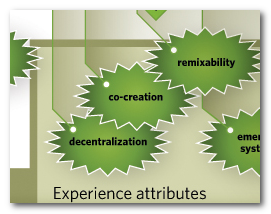
  • Experience attributes: de-centralization, co-creation, remixability, and emergent systems. Again, in Brandon’s words: “By blurring the lines that traditionally delineate supplier, vendor, and customer, these services have pioneered new value streams that can output new types of offerings, harness new efficiencies, and produce higher levels of continuous innovation.”

A quick analysis showed that the focus should indeed be on these experience attributes: the foundations were there, the basic system and processes work, things are happening. But they need to accelerate, explode, go viral. It still wasn’t hard to distinguish supplier, vendor, and customer in the current setup. We all could see new ways to offer new types of value to all stakeholders, but it was time to deliver, and the experience attributes nicely mapped onto dreams, visions, and ideas to move forward.

So with all the technical development just starting, and only some five months left to show concrete, measurable results, targets were mainly defined in terms of those experience attributes:

  • Get at least a couple of formalised partnerships to decentralize and scale up major parts of the organisational processes.
  • Get content in from a few dozen external sources, to remix with the user-generated content already there.
  • Provide new website tools to transform all of that content into compelling stories.
  • Provide new ways for people to share their experiences with their peers and promote the platform, and see them use those.
  • Double the overall amount of page views this way (ay, is this a web 1.0 metric slipping in after all?)

Ambitious goals, but more important: not just hoping on technical wizz-bang to solve things. Developing partnerships and compelling stories is far more a process and collaboration issue (and by far not easy to accomplish in half a year either, but work was already further on the way here). And if nothing else, burning some cash on advertising will provide a reasonably predictable growth of page views if needed — although I’m not supposed to take such a cynical view on these things (yet).

Back from FOSDEM in Brussels

fosdem.jpg

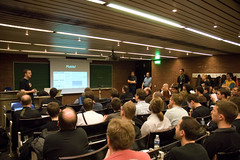
Back from FOSDEM in Brussels. In their own words on the information booklet: "4000+ geeks, 200+ lectures, 2 days, 0 EURO". I had two motivations to go there: Brussels is close to my home in Amsterdam and always nice to visit; and I could sit and listen a whole day to Drupal presentations, and get the opportunity to check out some other projects too.

As the FOSDEM booklet says, it’s a gathering focused on lectures, so I got my portion of sitting still and getting powerpoint-poisened in over-crowded and under-ventilated rooms. A lot of people breaking the "show me, don’t tell me" rule. But Brussels was nice, and some of the presentations on Drupal and Thunderbird were useful for me:

Drupal 7

Dries Buytaert presented the general direction for Drupal 7: taking the top feature requests from end users and developers from a survey as suggested priorities to work on by the community, to hopefully deliver a killer release by 2009 to succeed to recently released version 6.

The long-term focus will shift from modules and functionality towards data and inter-operability, being able to integrate content from different sources, allow others to reuse, and decentralisation: a general move towards RDF and its "subject-predicate-object" triples, and towards XML to better define web services interfaces, as well as allowing for object validation and so on.

"Search" in Drupal

Robert Douglass spoke about his ApacheSolr module: searching on Drupal is a disaster still, and he nicely demonstrated that by showing he couldn’t find a post of him complaining about this on drupal.org, but showed it was the first result via Google. Also, the search function on drupal.org had to be disabled a few times at high loads, because it would bring down the whole server.

So Robert built the ApacheSolr module to work with the Solr web service (which in turns works with Lucene for the indexing), and actually get better and more useful results on the content of the Drupal site. And Solr scales perfectly, and offers interesting extra options that make search a lot more useful.

See Christian Scholz’s blog post on this presentation for the details!

Mozilla Thunderbird

There also was a presentation on the recent launch of Mozilla Messaging, and the interest of Mozilla to make get to a staff of around 10 people working on Thunderbird as influential mail and calendar application by the end of 2008. The challenge is finding the right people to grow the team in the right way, funding seems to be no problem.

With a possible version 3 by the end of the year, including a calendar and better workflow, this all makes me feel a bit more confident again about the future of Thunderbird, after discussions a while ago seemed to suggest it might be abandoned.

In general

I found it interesting how people in some projects seem to look at the current/"old" situation with a relatively inward-looking orientation, and define themselves as an improvement over that; while others look more at "best of breed" practices, and seem to be more competitive and/or open. Drupal in my perception fits a bit in the former category, I had a bit the same feeling I had at BarCamp in Amsterdam in 2005: a very strong drive to "do it yourself" and a bit of a barrier of entry for outsiders.

Our first Nivocer office is open

2013_Klooster_Dolphia_-_voorzijde.jpg Klooster Dolphia (photo by Frea Bruintjes, 2013, from Wikipedia)

We’ve got our first Nivocer office space this month! My business partner Jaap-André is based close to Enschede, in the east of The Netherlands, and found this lovely former seminary-now shared office building not too far from his home, where we now have our first room and access to facilities in an inspiring setting. A building completed in 1937, but having a pretty rich history of use already. Far away from my Amsterdam home for Dutch standards, so I will continue looking for something closer by. Canadian friends remind me that a two-and-a-half-hour commute to work is not even really rare within the Toronto area, but my 1-minute journey to my home office is quite precious to me still. Meanwhile, Jaap-Andre is connecting his now truly separated business and private life with his recumbent bicycle.
·

Dear Humane Society International,

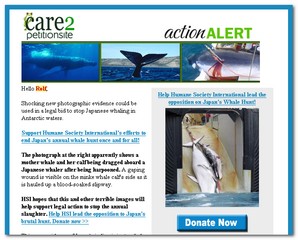
Today, I received an action alert from you, through my membership of Care2. It’s great to hear your contributing to the fight against Japanese whaling, but I was somewhat taken back by your approach. You’re asking me to “Help Humane Society International lead the opposition on Japan’s Whale Hunt!”. Pardon?

care2.jpg

Having worked at a desk next to the international anti-whaling campaign team of 2006-2007 of “another organisation”, your name wasn’t at the top of my list of anti-whaling campaigns. Frankly, it wasn’t at my list at all, and I’m sorry to say, I didn’t even know Humane Society International existed.

So I wanted to find out a bit more about your campaign. But…

  • All the links in the email go to a donation page (fair enough, with that big “Donate Now” button, it was pretty clear what you wanted from me).
  • Once on that donation page: still no clue about what your campaign was all about, and again: no links. Do you have a campaign?
  • So I hovered over the “please send us an email” link at the bottom of the page to find a web addres: www.hsi.org
  • The word “whale” doesn’t even appear on that page! And neither does the word “Japan”. It took me some fiddling around before I actually found something like a whale campaign page (with breaking news from 21 December?)
  • There is also a campaign page for the US organisation (where did I see that photo before? and where’s the photo credit for that photo in your email, who took that one?)

I applaud your efforts and involvement in this issue, trying to end to this ongoing unnecessary cruelty. It’s great you had a victory at the Australian court. But asking me out of the blue for a $100 suggested donation in this manner is really putting me off. You’re exploiting cruel images made by other organisations to fundraise for yourself. That’s not how I envision an organisation to “lead the opposition”.

Inspiration and hope?

As I am not from the US, I have no vote in the elections there. But as a world citizen, I am experiencing the choices made. I’m ambivalent about each trip I make to the US: going through the crazy bureaucracy at the border is a perfect way of demonstrating how much the US government likes to invade into my life.

The contrast with the people I meet once inside the country could not be bigger: many of them are passionate about making the world a better place, and equally feel their own government as the main obstacle in realising that. So with their elections this year, I’m trying to make sense of the candidates.

Of course, there’s the chance of Stephen Colbert taking on the challenge (I’m sure he has seen Man of the Year …).