Skip to content

Updates

Can you #IATI that for me? (1)

The IATI Standard lets you publish information on your organisation’s activities and money flows. But how exactly would you write something in IATI? That doesn’t always seem obvious, and certainly not for someone new to the XML standard.

This is the first of a series of sketches of situations that I encounter (or envision), with the question: can you #IATI that for me? We’ll start of simple.
iati1.jpg

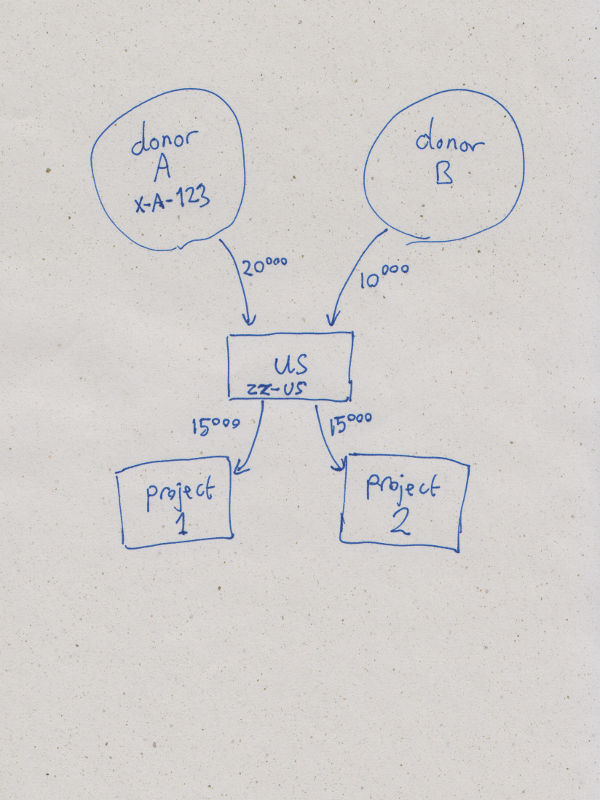
Our organisation, called Us, is going to publish data in IATI. We found out that our organisation identifier is  zz-us. (Not quite as we’d like to see, but the quiz is not about organisation identifiers.)

  • We receive funding from Donor A. They will contribute €20,000  to us. They publish IATI data too, and we found the IATI activity identifier for their grant to us in their file: X-A-123.
  • We also receive funding from Donor B. They will contribute €10,000 to our work this year.
  • We run two projects, Project 1 and  Project 2, each with a budget of €15,000.

Some questions:

  1. How do we indicate the budgets from our donors for our work?
  2. If we actually receive the money (€20,000) from donor A on, say, April 1st, how can we add that to our data?

Feel free to make up more information if you need it. Post your solutions as comments below. They’ll be kept hidden for the first few days, but then will be published for further discussion.

Do we all agree? Do we have different approaches? Is there a right or wrong way of doing it?

We have won an Honesty Oscar!

../../../assets/posts/ed137b78e00777dd4e6ff79fc736bca9_MD5.jpg

Friday last week, the ONECampaign tweeted Open for Change was  nominated for an Honesty Oscar. In their own words:

The Academy Awards is a time to celebrate the best films, actors and behind-the-scenes players in Hollywood – so why not do the same for the incredible videos, infographics and songs that help fight global corruption through creativity and innovation?

ONE is teaming up with Accountability Lab for the Honesty Oscars 2014, a week-long event to honor groundbreaking people and creative that make our world more transparent and hold our governments and corporations more accountable.

Take note (or loose notes)

../../../assets/posts/eb33d439c91c25dd96004db4b1caf5b8_MD5.jpg

I like a tablet-only travel style: going to conferences without a laptop. I usually just want to take notes, follow social media, and do email. A tablet gives me mobility, both in weight and in battery life.

But at OKCon last week, I had major fail. I have an Android tablet, and I had been using Epistle for some time: a simple but useful text editor, that nicely connected with Dropbox to make my files available on my laptop.

A recurring problem with text editing (on Android devices, at least) is the lack of undo options in almost any app. Swipe your finger slightly wrong, type a letter, and your precious text is gone. Forever.

The epiphany of “open” and IATI

../../../assets/posts/f2d9945890410b0f7536b53039a8d329_MD5.png

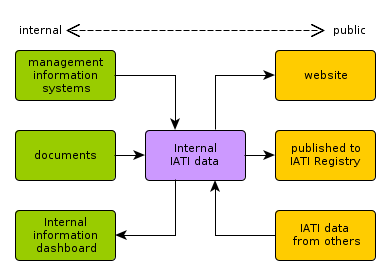
The IATI standard is meant to make it easier to exchange and compare information about activities and funding flows in development aid worldwide. But it can be useful within a (network of) organisations as well, even if you don’t feel ready to share that data with the rest of the world (yet).

Large organisations are starting to see the benefits: adapt your internal project management system so that it contains the necessary information in the right format, then export it to IATI data from there.

You then have an internal, vendor-independent format for your data, and have a choice of tools to put that data to use.