Skip to content

Conferences

Social Actions meetup in Oxford

In the middle of the Ecampaigning Forum, I’m trying to turn my notes about Monday’s “pre-ECF” session on Social Actions and the Change The Web contest into a blog post. Peter Deitz presented his vision on making opportunities for social activism available on the web, and together with Janelle Ward, Thiago Carrapatoso, Romina Oliverio, George Irish, Amy Sample Ward and Jonathan Waddingham, we looked at 8 of the submitted application for the Change The Web contest (deadline for submissions is this Friday!). Here are my notes of the discussions we had.

Social Actions for Facebook

Great appeal, could be promoted by an organisation to their Facebook constituency. Good presentation in search results, maybe more narrowed down would work better. Adding the “favicon” of sources as “bullets” to the list of promoted actions may be nice. Add promoted actions to your news feed so that friends can “share” and “like” those actions (“share” now leads to share the application, but several of us don’t like to add apps to my profile. Perhaps use the “redirect” mechanism in Facebook so that the Facebook toolbar is on the top of the page you and up, makes sharing easier too. Perhaps show the number of clicks on an action (is available in the Social Actions API?)

We had some concerns hether it should be a “destination site” (who would go there?) or should be a widget? Maybe just a widget based on specific topics? It might be nice to combine it into a service, so that when a topic I care about is trending, it will post a tweet on behalf of me? Or maybe send a tweet with an action for a trending topic? (This kind of adds to the “trending spam” that seems to emerge already, so not sure if it’s a really good idea). Or maybe combine this with something like cloud.li (makes a cloud of words you tweeted) with added actions?

Social Actions WordPress Widget

This plugin selects the actions to present based on the tags of the post (the plugin from Social Actions selects words from the whole page content). We liked the presentation with the emphasis on the action type. Although in our little groiup, WordPress also turned out to be the most-used blog tool, it might be relatively easy to clone this plugin into also a Drupal module?

Charity Meter

It mentions taking Open Social as a starting point, so we’re curious to explore more of the opportunity for this one (we didn’t quite see the Open Social aspect yet). It could also take the Facebook to a higher level. The idea of promoting things is generally shared, but not everyone would like to see the “dollar value” on it too (some would like to, others would be scared off, maybe this is related to cultural differences? So it would be great if it not only shows donations, but all kinds of social actions. And maybe it can then also suggest next actions for you based on your “action profile” (whether you’re more into giving or loaning money, volunteering, petitioning, etc.)

“Take Action” Button

We generally liked the button. We gathered a couple of suggestions for the pop-up. Maybe it could contain a link to “more actions like this”, or “previous/next” or “see another” options. A “share this” box may be nice too. Perhaps it also would be nice to have a few variations of the button, for instance with the Social Actions logo? Our main concern for this application right now, is that it is relatively hard to install. Perhaps it would be possible to deliver it as a WordPress plugin as well? Or make it more like a bit of javascript or code that you can more easily paste into a page?

SocialActions iPhone application

Yes we need an iPhone application 🙂 Bringing actions to your (i)phone is obviously interesting. It would be great if those actions would be actions that you can do from your phone, or close to where you are. TheExtraordinaries are building a similar tool. It would be really great if it also works with “social networking” features, for instance find friends in the same March? Also, it would be great if what you contributes to a “bigger picture” somehow, as a form of crowd sourcing. An example that was mentioned: safe bicycle routes. By using the GPS on your phone and cycling a route, you can then upload it as a “safe route”, and make it part of a bigger map and route planner.

SocialActions Search for Firefox

Right now, it adds a search engine. It’s powerful in its simplicity, but we had some discussion on who would use it (not everyone uses the search box). We discussed some additional features mainly, like a toolbar in Firefox, or a sidebar application with opportunities around the page you’re looking at (like the Knowmore addon for Firefox.

Search for Social Actions

Peter already explained how Social Actions will be working on their search interface, so seeing this submission kind of felt like a great start for that. Especially the idea of having permalinks for searches is good, and it would be great if the search engine could be tailored and made available as a widget, for instance to put actions around “Earth Day” on a web page, or allow people to search “human rights” activities on your site. The RSS feeds on search results is great too. It would be great to add keyword highlighting to the results.

Thanks!

That’s it. Thanks for all the submitters of applications, and all the participants on Monday. I really got a better sense of what Social Actions is, and could grow into. (We had a conversation about Open Actions at the following Ecampaigning Forum, but need to write that up still.)
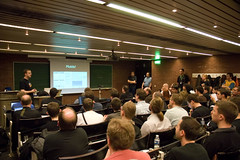
Going Open! Thursday at the Transnational Institute

First post here after a long silence… maybe too busy with twitter, Nabuur, WebEnq, Ecampaigning Forum, NetSquared. And now preparing my short intro into "open everything" to set the stage for Thursday’s meetup of the E-collaboration group.

Within a smaller group, we had some discussions about "open", and about how choosing technology for your campaign or organisation is also a political, cultural, and ethical choice. Features and price often dominate, and lots of stuff on the internet is for free. But there’s no such thing as a free lunch: there are many lessons we learned in development aid that equally apply when your organisation gets such "free" web development aid. Lets not spend decades to learn them again.

So while on the one hand, people are trail-blazing the concept of "open everything", there are, on the other hand, many people working in international cooperation who are just starting to look at why all this "open" matters, and how it can help them achieve their mission.

We’ll be trying to bridge that gap on Thursday afternoon:

12.00 – 13.00 Welcome, coffee & tea

13.00 – 13.20 Getting acquainted

Plenary

13.20 – 13.30 Introduction into the "OPEN" field by Rolf Kleef

13.30 – 14.00 Concepts behind Open Standards and Free Software (Open Source) by Anne Sedee

Group workshops

14.00 – 14.45 Two group workshops

Plenary

14.45 – 15.15 "Learning in Freedom: Open Content and Open Educational Resources" by David Jacovkis (Free Knowledge Institute)

15.15 – 15.30 Coffee and tea break

Group workshops

15.30 – 16.30 Two group workshops

  • ‘making knowledge open and accessible’, experiences from the development community by Peter Ballantyne (Euforic)
  • Debate Game: People bring in a case about an open/ closed dilemma

Evaluation & closing

16.30 – 17.00 Presentations and evaluation.

17.00 – 18.00 Borrel

The meeting will take place on 22nd May 2008 at Transnational Institute in Amsterdam, The Netherlands. There are still a few places left, so get in touch if you want to join!

Back from FOSDEM in Brussels

fosdem.jpg

Back from FOSDEM in Brussels. In their own words on the information booklet: "4000+ geeks, 200+ lectures, 2 days, 0 EURO". I had two motivations to go there: Brussels is close to my home in Amsterdam and always nice to visit; and I could sit and listen a whole day to Drupal presentations, and get the opportunity to check out some other projects too.

As the FOSDEM booklet says, it’s a gathering focused on lectures, so I got my portion of sitting still and getting powerpoint-poisened in over-crowded and under-ventilated rooms. A lot of people breaking the "show me, don’t tell me" rule. But Brussels was nice, and some of the presentations on Drupal and Thunderbird were useful for me:

Drupal 7

Dries Buytaert presented the general direction for Drupal 7: taking the top feature requests from end users and developers from a survey as suggested priorities to work on by the community, to hopefully deliver a killer release by 2009 to succeed to recently released version 6.

The long-term focus will shift from modules and functionality towards data and inter-operability, being able to integrate content from different sources, allow others to reuse, and decentralisation: a general move towards RDF and its "subject-predicate-object" triples, and towards XML to better define web services interfaces, as well as allowing for object validation and so on.

"Search" in Drupal

Robert Douglass spoke about his ApacheSolr module: searching on Drupal is a disaster still, and he nicely demonstrated that by showing he couldn’t find a post of him complaining about this on drupal.org, but showed it was the first result via Google. Also, the search function on drupal.org had to be disabled a few times at high loads, because it would bring down the whole server.

So Robert built the ApacheSolr module to work with the Solr web service (which in turns works with Lucene for the indexing), and actually get better and more useful results on the content of the Drupal site. And Solr scales perfectly, and offers interesting extra options that make search a lot more useful.

See Christian Scholz’s blog post on this presentation for the details!

Mozilla Thunderbird

There also was a presentation on the recent launch of Mozilla Messaging, and the interest of Mozilla to make get to a staff of around 10 people working on Thunderbird as influential mail and calendar application by the end of 2008. The challenge is finding the right people to grow the team in the right way, funding seems to be no problem.

With a possible version 3 by the end of the year, including a calendar and better workflow, this all makes me feel a bit more confident again about the future of Thunderbird, after discussions a while ago seemed to suggest it might be abandoned.

In general

I found it interesting how people in some projects seem to look at the current/"old" situation with a relatively inward-looking orientation, and define themselves as an improvement over that; while others look more at "best of breed" practices, and seem to be more competitive and/or open. Drupal in my perception fits a bit in the former category, I had a bit the same feeling I had at BarCamp in Amsterdam in 2005: a very strong drive to "do it yourself" and a bit of a barrier of entry for outsiders.

NetSquared Online Sessions

I am in San Jose now, just a few hours away from the opening reception of NetSquared, probably the biggest "Web 2.0" conference I will be attending for a while, with some 350 participants expected. Many many interesting talks and sessions proposed, including a parallel online event, with two important items.

Tuesday 30th May, 11AM PST (which is 8PM Western Europe, 7PM UK, 6PM UTC) I will have an hour session on our Custard Melt project, and especially on what our ambitions and expectations are. I hope that many people will join to explore how we can make the online platform help in galvanising offline action.

At 4PM PST, 1AM Western Europe, midnight UK, 11PM UTC, Micki Krimmel of Participant Productions will be online for a session on "Media that Mobilizes: An Inconvenient Truth, ClimateCrisis and more tales from Participate.net". Of course, as the producers behind Al Gore’s movie about climate change, this is of particular interest to us.