Skip to content

Ideas

Stable communities and the Suck Principle

[no-entry-for-general-public.jpg secretlonden123

“For anyplace to stay cool it has to suck.” Dmytri Kleiner wrote up some interesting thoughts on making communities more continuous and stable. When a place becomes too cool, it becomes too crowded, and the regulars are replaced by a more transient crowd that has no deep bonds to the community of regulars. Referring to a quote by Yogi Berra, “ nobody goes there anymore, it’s too crowded “.Dmytri draws on his experience with 28C3, the latest Chaos Computer Congress, held yearly at the end of December, in Berlin, and proposes The Suck Principle:

“Everything I need to know about open data, I learned from open source”

okf2011.jpg

BoF “Open data in development” at OKCon (via Tobias Eigen)

But what did we learn from open source? Two days of Open Knowledge Conference gave lots of food for thought. And lots of inspiration as well: plenty of projects doing interesting work, and experiences to share. And to add a cherry to the cake, we had a great “open lunch for development” with several people active in development aid. My (delayed) take-aways for Open for Change.

From data.gov.* to data.your.org

Nigel Shadbolt and Andrew Stott shared their lessons from setting up data.gov.uk, and Tom Lee talked about data.gov and the recent threats of its budget cuts.

It’s crucial to have top-down support, bottom-up activists, and middle-tier connectors, to bring everything together.

  • We need to continue nurturing a network of people active in open data for development, to make sure we have the tools, ideas, reports, cases, and standards we need, and to support the early adopters within organisations.
  • We have done some work on an “open data briefing”, based on the OKFN open data manual, and we need to continue work on that: in four pages, explain the why, how, what and who of opening up your organisation.
  • It’s important to understand the decision-making and budgeting processes to make the case at the right time and the right place. We could review the best material on “how to convince your boss to use open source” as a starting point.

There are many reasons to embrace open data, don’t rely on a single one to make your case: tranparency and accountability; economic value, growth and innovation; efficiency and cost-effectiveness; improving (public) services; (public) engagement; and civil society and social capital.

Close the feedback loop: the “build it and they will come” approach won’t work here either. Try to publish data that matters to people, but also consider that “data probably has a long tail”.

  • Releasing data early and incrementally creates a steady news flow, and also enables you to work with feedback and to champion people to create peer pressure on the “refusniks”.
  • Friedrich Lichtenberg tries to turn the lack of opportunity to debate what you see in “ Where does my money go ” into an opportunity for “ Open Spending ”. In essence: how do we provide support to create a data cycle instead of a data pipeline.
  • There is a challenge to create or appoint authoritative sources and URIs. In fact, this was a key topic in the online workshop organised by David Pidsley during the Open Data for Development Camp.
  • In a broader sense, the emerging standards and work done on open data in development cooperation needs to settle down in one or more ontologies. This will also pave the way to build more focused data enrichment services that can tap into the existing wealth of documents we have, to help professionals navigate those.

Statutory requirements matter.For governments, this mainly has to do with legal frameworks and obligations. But every organisation could (and should) enshrine crucial elements of open data in their policies: how to ensure “open” stays open, and how to prioritise.

  • The UK government re-used lots of existing policies, such as the National Statistician’s guidelines about reasonable measures to prevent identification of individuals. The open data manual could be a good portal to such policies.
  • Principles and policies should not be set in stone (at least: not early on), to prevent weasel words like “to the extent feasible” creep in. The essential lesson: in the first phase, compromise on the data that will be published, but not on the license applied to it. (Again: the paradigm shift in thinking and acting is what matters first.)

Why we want to be open: the fallacy of community collaboration

In open data, a lot can be learned from “open source”. In terms of tools and practices, I think we are, but in terms of the stories we tell ourselves and others about why we do it, Benjamin Mako Hill gave some interesting insights on the promise of open source to create better software because more people will be able to see, comment on, and improve the code.

In reality, this hardly happens. He showed graphs of projects on Sourceforge, the first major hub of open source software. The median number of developers working on a project is one. If you only look at “mature projects” (multiple releases, longer history), the median is still one. If you look at the most popular projects (10% of most downloaded), the median is two.

In other words: there are very, very few projects where mass collaboration did happen.

And we actually don’t really understand why some of them succeed.

It doesn’t mean we should not do open source, but we should not promote it with the story that it leads to peer review and better code. There are plenty of other reasons, though, and we should make sure we capture those in our Open for Change Manifesto as well:

  • It gives the users freedom: autonomy, control and empowerment. The technology constrains how and what we can communicate as people. Openness allows you to remove barriers.
  • It is resistant to “anti-features” (limitations built in to charge for removal). With an open license, anyone can process a data set to make it more useful for themselves or others.
  • It makes failure cheap: since the investment to be open is low, there already is reward in just making your own solution available.
  • It also makes success cheap: some products failed to have a big enough market to sustain a company producing it, but a community of users can produce and maintain it.
  • It is not dependent on persons or organisations: even if the original producer(s) stop working on it, others can continue and keep it available.
  • It sometimes does lead to mass collaboration. And it then can produce something that would be impossible to organise through traditional means.

Why we want to be open: a stronger vision

In our beta Manifesto, we tried to capture the essence of why we want to be open, and OKCon was a chance to reflect on it.

I liked a definition given by Jose Alonso of the Web Foundation: the web is humanity connected through technology. And as Brewster Kahle of archive.org said: the last generation put a man on the moon. Pretty cool, but our generation can make all knowledge available to all people on earth, for always and for free. That’s a powerful ambition too.

It is crucial to also translate the promise of open data, open access and open knowledge to “effective use”: how do we make sure we create autonomy, control and empowerment, but more even so: security for the ones who want to realise their “ right to access”? “Open” is part of a struggle for human rights.

Hopefully, a joint “Slash Open” campaign can unite the efforts of many organisations working for humanity in shaping the technology we need and put it to effective use.

Open for discussion: the "Open for Change" Manifesto

Ever since we started networking as “development 2.0 pioneers”, we wanted to express our core values, so we can grow our network into a movement.

In January we adopted the name “Open for Change”, and worked to organise the world’s first “Open Data for Development Camp” (ODDC) in May, to bring together the people in that movement.

Based on the conversations we had with many of you (before, during and after ODDC), and inspired by other manifestos, we now have created a beta version of the Manifesto for Open for Change, and love to hear your feedback.

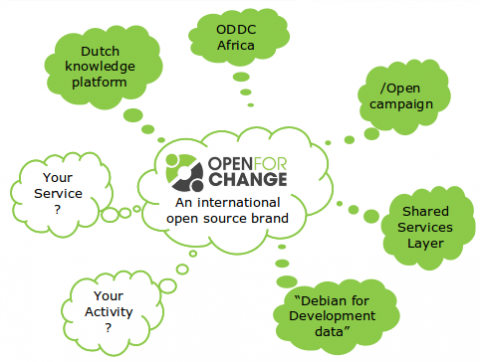
The Manifesto is the foundation for more plans and activities to grow our global movement. Schematically, it could look like this:

ofc-ideas.png

We see “Open for Change” as an open source brand and as an international ecosystem, based on the Manifesto and with a light-weight organisational and technical structure to connect various projects and activities:

Most of these are in their conception phase, some are already starting to take shape with people working on it.

Our focus now is to get feedback on the Manifesto and to hear your thoughts on the “open source brand” and the organisational form it should take.

Click here to go to the Manifesto and give your feedback! Leave a comment, and forward this message to people you think should be involved! Thanks!

Let’s build a “Debian for Development Data”

I just returned from an intense week in the UK: an IKM Emergent workshop in Oxford, and the  Open Government Data Camp in London had me almost drowning in “open data” examples and conversations, with a particular angle on aid data and the perspectives of international development.

As the result of that, I think we’re ready for a “Debian for Development Data”: a collection of data sets, applications and documentation to service community development, curated by a network of people and organisations who share crucial values on democratisation of information and empowerment of people.

“Open data” is mainstream newspaper content now

Mid 2009, after the 1%EVENT, a couple of innovative Dutch platforms came together to explore the opportunities of opening up our platforms: wouldn’t it be great if someone in an underdeveloped community had access to our combined set of services and information?

We had a hard time escaping new jargon (federated social networks, data portability, privacy commons, linked open data, the semantic web) and sketching what it would look like in five years. But then again, suppose it was five years earlier: in mid 2004, no-one could predict what Youtube, Facebook and Twitter look like today, even though many of us already felt the ground shaking.

  • The technical web was embracing the social web, of human connections.
  • The social web pushed “literacy”: people wanted to participate and they learned how to do that.

A year and a half later, “open data” is catching up with us, and going through a similar evolution. Governments and institutions have started to release data sets (the Dutch government will too, the UK released data on all spending over £25,000 on Friday). So when will the social dimension be embraced in open data?

A week of open data for development

At an IKM Emergent workshop in Oxford, on Monday and Tuesday, around 25 people came together to talk about the impact of open data on international development cooperation. We discussed when we would consider “linked open data” a success for development. One key aspect was: getting more stakeholders involved.

Then at Open Government Data Camp (#OGDCamp) in London, on Thursday and Friday, around 250 people worked in sessions on all kinds of aspects of open data. Several speakers called for a stronger social component: both in the community of open data evangelists and in reaching out to those for whom we think open data will provide new opportunities for development.

At IKM, Pete Cranston described how his perception of access to information changed when a person approached him in a telecentre to ask how the price of silk changed on the international market: he was a union representative, negotiating with a company who wanted to cut worker salaries because of a decline in the market price. Without access to internet or the skills to use it, you don’t have the same confidence we have that such a question can be answered at all.

Then at OGDCamp, David Eaves reminded us that libraries were (partly) built before the majority of the population knew how to read, as an essential part of the infrastructure to promote literacy and culture 1.

Telecenters fulfil a role in underdeveloped communities as modern-day libraries, providing both access as well as the skills to access information and communication tools via the internet.

But we don’t have “open data libraries” or an infrastructure to promote “open data literacy” yet.

How open source software did it

It shouldn’t be necessary for people to become data managers just to benefit from open data sets. Intermediaries can develop applications and services to answer the needs of specific target groups based on linked open data, much as librarians help make information findable and accessible.

There are also parallels with open source software. Not every user needs to become a developer in order to use it. Although it is still to think otherwise sometimes, the open source movement has managed to provide easier interfaces to work with the collective work of developers.

The open data movement can identify a few next steps by looking at how the open source movement evolved.

Open Source Open Data
Software packages (operating systems, word processors, graphics editors, and so on) are developed independently. Each software package can choose the programming language, development tools, the standards and best practices they use. Data sets (budget overviews, maps, incident reports) are produced independently as well. The data formats and delivery methods can be chosen freely, and there are various emerging standards and best practices.
Communities around software packages usually set up mailing lists, chat channels and bug trackers for developers and users to inform each other about new releases, problems, and the roadmap for new versions. The mantra is “many eyes make all bugs shallow”: let more people study the behaviour or the code of software, and errors and mistakes will be found and repaired more easily. Data sets mainly are published. As Tim Davies noted in one of the conversations, there don’t seem to be mailing lists or release notes around data sets yet. To deliver the promise of a “wisdom of the crowds”, users of data sets should have more and better ways to provide feedback and report errors.
Open source software is mostly used via distributions like Debian, Redhat, Ubuntu, separating producers and integrators. A distribution is a set of software packages, compiled and integrated in a way that makes them work well together, thereby lowering the barrier of entry to use the software. Distributions each have a different focus (free software, enterprise support, user-friendliness) and thus make different choices on quality, completeness, and interfaces. Perhaps the current data sets released by governments could be considered “distributions”, although the producer (a department) and the integrator (the portal manager) usually work for the same institution. CKAN.net could be considered a distribtion as well, although it does not (yet?) make clear choices on the type and the quality of data sets it accepts.

Software distributions make it possible to pool resources to make software interoperable, set up large-scale infrastructure, and streamline collaboration between “upstream” and “downstream”. The open character stimulates an ecosystem where volunteers and businesses can work together, essential to create new business models.

Towards a “Debian for Development Data”

To sum up several concerns around open data for development:

  • Open data is currently mainly advocated for by developers and policy makers, without a strong involvement of other stakeholders (most noteworthy: those we like to benefit in underdeveloped communities). It tends to be driven mostly by web technology and is mostly focused on transparency of spending. It does not take into account (political) choices on why activities were chosen, and also lacks a lot in recording the results.
  • Data sets and ontologies are hard to find, not very well linked, with few generic applications working across data sets, and examples of good use of multiple data sets. Once you want to make data sets available, it is hard to promote the use of your data, provide feedback loops for improvements, administer dependencies, and keep track of what was changed along the way and why.
  • There are hardly any structural social components around current open data sets, repositories and registries.

So why don’t we start a “Debian for Development Data”?

  • A Social Contract and Open Data Guidelines like those for Debian can capture essential norms and values shared by community members, and inform decisions to be made. The contract can for instance value “actionable opportunties” over financial accountability. The Agile Manifesto is another example to draw from.
  • The community should set up basic communication facilities such as a mailing list, website, and issue tracker, to ease participation. Decision-making is essentially based on meritocracy: active participants choose who has the final say or how to reach consensus.
  • The data sets should be accompanied by software and documentation, to take away the problem of integration for most end users. Each data set and tool should have at least one “maintainer”, who keeps an eye on updates and quality, and is the liaison for “upstream” data set publishers, offering a feedback loop from end-users to producers.
  • The CKAN software (powering the CKAN.net website mentioned before) draws on the lessons from distributions like Debian for its mechanisms to keep track of dependencies between data sets, and has version control, providing some support to track changes.
  • Ubuntu divides packages in categories like “core”, “non-free” and “ restrcited” to deal with license issues, and to express commitment of the community towards maintaining quality.

We stimulate the social component by providing more stakeholders a point of entry to get involved through socio-technical systems. We stimulate literacy by offering the stakeholders ways to get open data, publish their own, experiment with applications, and learn from each other. And we circumvent the tendency towards over-standardisation by doing this in parallel with other initiatives with sometimes overlapping goals and often different agendas.

1A quick check on Wikipedia indicates this seems to have mainly been the case in North-America, though.

Tasktop to improve a knowledge worker’s productivity

I’ve been using Mylyn for quite some years now. Mylyn introduced the concept of task-focused work: activate a task in your to-do list, and only see the files relevant to that task. Tasktop, the company behind Mylyn, extends Mylyn as Tasktop, with even more features, and promises “improved productivity, guaranteed.”. It works great when I am developing software, and also could support me as knowledge worker, for instance by managing bookmarks and browser tabs in Firefox. But I’d like to see it offer more support for task management within Firefox too. A bit like this.

Mylyn and Tasktop

If you’re a developer, you probably at least had a look at Eclipse at some point. And perhaps at the Mylyn extension, to connect it to various bug trackers to populate your to-do list. It provides a standardised way of keeping track of issues in bug trackers, and helps to focus on the files relevant to a specific task. Switching from one task to another becomes lots easier, and so the cognitive overhead of managing tasks (especially finding the files associated with a task) is reduced significantly. As Mik Kersten, one of Mylyn’s masterminds, demonstrated in his PhD 1.

Mik founded Tasktop, a company that takes the “task-focused desktop” approach even further, connecting Mylyn also to email (Outlook, Gmail, IMAP) and to the Firefox web browser.

And Mylyn and Tasktop have a lot more features, many of which I am not – or perhaps: not yet – using.

From developer to knowledge worker

These days, I hardly get to spend time on programming, but instead spend most of my time as knowledge worker. Firefox is now my predominant “desktop”, and I find myself flipping back and forth between Eclipse and Firefox quite a bit.

The people at Tasktop have been very responsive to feedback, and thereby also encouraged me to make regular contributions to their issue tracker, mostly with suggestions for improvements or new features. So I filed a suggestion to expose more of Mylyn and Tasktop in a Firefox extension.

I recently decided to try out Wireframesketcher, another Eclipse plugin, developed by Petru Severin, to sketch a bit how I think an extended TaskTop addon for Firefox might help me better.

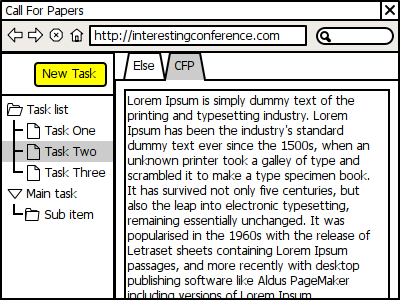
Use case: stumbling upon a new thing for my to do list

tasks-1.png

Step 1: See an interesting page

I somehow end up on a page in my browser for a conference, event, or topic I am interested in. For instance via email, a chat, a twitter message, a phone call, a visitor in my office. I want to quickly make a new task to capture what I’m looking at.

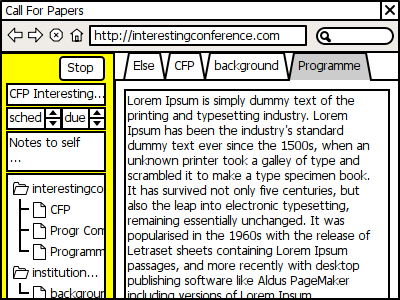
tasks-2.png

Step 2: Collect information

Once I created the task or activated it, I want to perhaps add a few pages to the task context, and perhaps some notes or a copy of some text on a page. And maybe schedule it or add a due date, for instance a deadline for registration, or for submitting a proposal or a paper.

Ideally, the task context could also add downloaded files to the context.

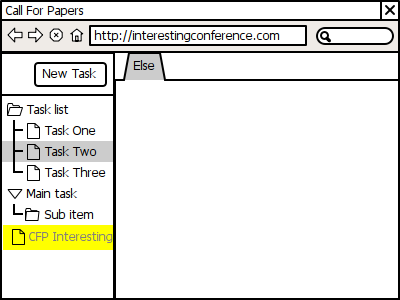
tasks-3.png

Step 3: Back to previously active task

And then I want to go back to the task I was working on, or another one on my schedule.

In summary, my wishes:

  • create a new task or switch to another task within Firefox, without switching to Eclipse;
  • have access to notes, task context (especially bookmarks and visited pages), and scheduled and due dates
  • be able to add or remove pages that I have open to my task context.

1 Mik Kersten, “Focusing knowledge work with task context” (Vancouver, BC, Canada: University of British Columbia, 2007), http://www.tasktop.com/docs/publications/2007-01-mik-thesis.pdf.

Goodbye to the gatherers, welcome to the web: mammoths and modernity.

Imagine the first farmers: they lived in a society of hunters and gatherers. Every so often, you’d pack up your stuff and move along, to follow your food. Find new things to eat, because you’ve exhausted the place you lived in.

earlyman.jpg

The farmers introduced a new way of thinking: what if we could just grow our food in one place? That would save the effort of travelling around. So they started experimenting: sowing seeds, taking care of the young sprouts, trying to cultivate their plants. Until it was harvest time: reap the benefits of your labour, indulge in cornucopia for a while, store a bit, and start working on the next cycle.

The hunters and gatherers must have looked upon those folks as weird people: building houses ("sure, nice to live in but not very practical on your travels!"), creating ploughs and tools ("great way to move dirt, but how are you going to catch a mammoth or pluck a berry with that?"), storing food in storages ("won’t the mice and the rats just run with it?"). The hackers and nerds of their times, saying "go ahead and chase your mammoth, I’ll see you around, next Summer".

The farmers prevailed. They changed the way society works in most places on the world. We try to stick to where we are, and we even make rituals and routines around that, to affirm our convictions and location. And most of us are no longer involved in producing food, but rather in pursuing other goals.

I’m working in the field of international development collaboration. I often feel like a farmer, talking to hunters and gatherers, about what "web 2.0" is really about. Oh, he’s a techie, an engineer. But I’m experimenting with ways to grow compassion, engagement, collaboration. Online communities? Blogs and bookmarks? RSS and wikis? Social networking? Sure, but won’t the rats just eat your products while you’re having a party?

We don’t eat a lot of Mammoth Burger these days. And we could cultivate collaboration towards a common goal, without sacrifice or giving up (a lot of) our current live. We can build a global society based on solidarity, without loosing identity or community.

Lets move from chasing to cultivating.

(photo: CC-BY-SA-NC-20 by Poo-tee-weet?)

Flying saucers, flow and serendipity shape the web

Recently, my work has moved again towards "concept" and "facilitation", into the realm of the unknown, the things to be discovered. Especially around online collaboration, platforms to facilitate that, and internet strategies and architectures to support such processes: Web of Change, WijZijnMedia, NABUUR, Internationale Samenwerking 2.0 (in Dutch for now). It’s all about new community-organising strategies and tactics, and I love it: a potent mix of "where do we go from here" and "what will we have built by the end of today". Pragmatic idealism: punk+utopia with web 2.0+mobile as catalyst, or perhaps: "do it yourself serendipity". But also: how to let flying saucers get you there. Mihaly Csikszentmihalyi’s talk at TED and Matt Leacock’s Google Tech Talk guide me.

"The travels and adventures of Serendipity" is a book, given to me by a dear one, about sociological semantics and the history of the term "serendipity". And although my short life seems full of serendipity, I haven’t paid proper respect yet to both the book and the gift and the idea, by reading it. I’m more of a "watching" person, absorbing presentations, documentaries and films over reading a book. Maybe soon, but until then, here are two (connected) examples to show what I understand by "serendipity".

First, I watched Mihaly Csikszentmihalyi talk at TED about his chance encounter to get into the psychology of flow through flying saucers. His TED question "What makes a life worth living?" touches deeply on the kind of talks we have at Web of Change, the kind of work that made Obama’s campaign so successful, and NABUUR’s concept so addictive: once you feel connected, you can take on the world, and once you’re in flow, you change reality:

Then I watched Matt Leacock’s Google Tech Talk on how he used the principles of Mihaly Csikszentmihalyi to guide his design of a cooperative game: Pandemic. As players, to win you basically need to beat the system ("the algorithm" as he puts it — any similarity to Google and the "Society of the Query" conference in Amsterdam this week is purely serendipituous, not coindicental). The link between Pandemic and current society obviously is left as an exercise to the reader, and I encourage you to watch till the end: the Q&A with Matt had some insightful moments for me.

Around an hour and a half watching time to put ideal theories into practice, pretty close to where I work right now. Matt’s takeaways common to game design and user experience design are worthwhile.

Curing “Data Hugging Disorder”

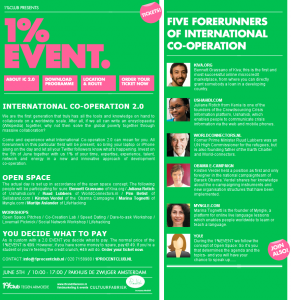
Last Friday, the 1%Club held their (first, probably not last) 1%EVENT, about “international development cooperation 2.0”. I facilitated a session on “connecting the platforms”, to pave the (technical) way towards a cure for what Ushahidi’s Juliana Rotich aptly referred to as “ Data Hugging Disorder “. It resulted in a positive discussion with several people of organisations that build or host online platforms. Coming Monday, I hope the discussion continues at a meeting in The Hague about a possible Dutch IS-Hub.

Tools, platforms, exchange, goals

1pevent.png

The evolution of international development cooperation in a nutshell:

  1. first we tried to build the best water pump
  2. we realised we need to build the right water pump
  3. then we started to exchange lessons learned about building water pumps
  4. and now we have the Millennium Development Goals to let all water pump work contribute to a common goal (in this case: “ Target 7.C: Halve, by 2015, the proportion of people without sustainable access to safe drinking water and basic sanitation “)

“International Development Cooperation 2.0” heavily depends on using ICTs as tools for collaboration. In essence, my feeling is we’re repeating the process in building online platforms: some people still want to build the best platform, most are busy building the right platform for the situation, and (as the session proved) are getting ready to exchange the lessons we learn, and for standards to work towards common goals.

Open standards as a way forward

With several people in the room with (information-)technical affinity, the discussion quickly moved to open standards to choose or to develop. Although there are many concerns about privacy, identity, and security, an important breakthrough was that most of those concerns are not at all specific to the field of international development cooperation. We should make sure our concerns are documented, but more likely than not, those concerns will be addressed in some form by the big platforms. For the exchange of “actionable opportunities”, the Open Actions format is just emerging. The uncharted territory seems to be information around projects in international development.

Probably no coincidence: some of my current consultancy work is on project administration and project management solutions in such a context. Logframes are popular vehicles for project goals information, but so far I haven’t found clear patterns in how organisations deal with their projects and programmes from a management process point of view. Maybe this is the area where the conversation still needs to develop before standards can emerge.

A Dutch IS-Hub?

The time is apparently right to get to standardisation: indepently, Cordaid and their platform development company have initiated a discussion on Monday about how to deal with the technical, organisational and legal aspects of sharing information and reducing redundancy for people in building up expert profiles and making them available on various platforms.

Again, this is not an area specific to international development cooperation, so hopefully a chance to benefit from the work in many other places. Not so long ago, Aldo de Moor and I visited D-CIS at Delft University, where they try to solve similar problems in a different domain: how do you create “actor-agent systems”, where software helps a crisis manager to quickly get to the right expert in the case of a disaster. How to harvest expert profiles across many fields of expertise and organisations, and also take into account that an expert is not an expert anymore after 48 hours without sleep…

Making “data portability” the next “accessibility”

As the Dutch Ministry of International Cooperation is shaking up the NGO world here in The Netherlands. “Collaboration” and “Partnerships” are the new buzz words, and since “2.0” is part of the official policy, many organisations are slightly panicing about how to move forward, and how to quickly embrace some of that “2.0”. A great time to leapfrog for the Dutch international development cooperation world.

Over the years, “accessibility” has become a standard requirement for web sites. It’s easy for a client organisation to demand compliance to a certain level of accessibility as specified in open standards. It would be great if we now can move to a similar model with levels of “data portability”, to get NGOs to add those to the requirements of their next platform.

Hopefully, Monday’s discussion is a next step towards such a standard requirement, and also offers a common road map for the platform builders. That would also open up the opportunities for BarCamps and such to join forces on implementation.

A quick guide to standards

Here’s a dump of the standards mentioned at Friday’s meeting (not linked yet, but maybe one day):

  • News, updates: RSS, well-accepted by now
  • Identity and authentication: OpenID, OAuth
  • “Social actions”: Open Actions
  • Projects: Open Archive Initiative as meta-level, Dublin Core, DIDL, OpenPro
  • Constituency, membership:?
  • Social networks: FOAF, XFN
  • Applications: Open Social, Facebook Connect?
  • Payments: mobile banking? how to do payments?
  • Market places:?

Raw notes of the session

After an intro by Niels about the importance of open source and free software as a basis, and my intro about Social Actions, the Change The Web contest, and the emerging Open Actions format, almost all of the 25 or so attendees (note to self: build a list of participants again next time!) shared their concerns and aspirations. I have tried to write down key elements I heard, here’s the raw dump of the flip chart notes:

  • How to work together? Technical standards seem feasible, pride and identity seem to get in the way.
  • What are the standards we should focus on?
  • Is there any form of collaboration already?
  • What open standards for exchanging projects are there? Is it about project information, how to deal with quality, what about the social networking around it?
  • How to get away from having profiles on many different sites?
  • How to enable collaboration on many different platforms?
  • How to make the collaboration itself central: from social network to collaboration network?
  • For example: how to get Kiva into your project environment, rather than your project into Kiva?
  • Concerns about identity, safety, privacy, security. How to keep control over where your information and identity is going?
  • What formal ways are there to capture documentation?
  • How to activate people who normally wouldn’t be active or interested in this context?
  • Can we enable knowledge sharing through micro-blogging?
  • How to guide the choice of a platform?
  • How would we even define “platform”, are we all talking about the same thing when we use that word?
  • Lets create best practices, compatibility, and meta standards. But: we can’t do that, “Google should do it” and “Facebook wins”.
  • Types of information we could share, standards in that area we could use (see earlier in this post).
  • Which platform gets what part? For instance: the business model of one platform is based on taking a percentage of the funds raised – how to deal with that when adding the fund raising feature to another platform?

Thanks 1%Club

For the 1%EVENT, Bart and Anna walked the talk, listened to all the suggestions made to them over time, and had two great Open Space facilitators to set up the day’s agenda. Maybe not every attendee and “poster pioneer” felt comfortable with it at once, but the co-created, slightly chaotic and creative sequence of events was precisely the kind of event I missed in The Netherlands so far!

Clay Shirky as my Sound Byte Hero

I haven’t managed to write (publicly) for some time: new projects kept me busy, either launching, or preparing. But thanks to a tweet by Planspark, I read (yet another) piece by someone who is becoming my personal “Sound Byte Hero”: Clay Shirky. At the moment, Siegfried Woldhek and I are preparing a position paper on how International Development Cooperation will change, as part of a series of debates with existing organisations and the Minister for Development Cooperation here in The Netherlands. So when my friend Tim Bonnemann send out a tweet today “Must-read of the day: Clay Shirky’s “Newspapers and Thinking the Unthinkable”, I summarised the take-away quotes for me.

My personal selection of “quotable quotes” from Clay Shirky’s “Newspapers and Thinking the Unthinkable”

“With the old economics destroyed, organizational forms perfected for industrial production have to be replaced with structures optimized for digital data. It makes increasingly less sense even to talk about a publishing industry, because the core problem publishing solves — the incredible difficulty, complexity, and expense of making something available to the public — has stopped being a problem.”

“As novelty spread, old institutions seemed exhausted while new ones seemed untrustworthy; as a result, people almost literally didn’t know what to think. If you can’t trust Aristotle, who can you trust?”

“And so it is today. When someone demands to know how we are going to replace newspapers, they are really demanding to be told that we are not living through a revolution. They are demanding to be told that old systems won’t break before new systems are in place. They are demanding to be told that ancient social bargains aren’t in peril, that core institutions will be spared, that new methods of spreading information will improve previous practice rather than upending it. They are demanding to be lied to.
There are fewer and fewer people who can convincingly tell such a lie.”

““You’re gonna miss us when we’re gone!” has never been much of a business model”

“Imagine, in 1996, asking some net-savvy soul to expound on the potential of craigslist, then a year old and not yet incorporated. The answer you’d almost certainly have gotten would be extrapolation: “Mailing lists can be powerful tools”, “Social effects are intertwining with digital networks”, blah blah blah. What no one would have told you, could have told you, was what actually happened: craiglist became a critical piece of infrastructure. Not the idea of craigslist, or the business model, or even the software driving it. Craigslist itself spread to cover hundreds of cities and has become a part of public consciousness about what is now possible. Experiments are only revealed in retrospect to be turning points.”

““If the old model is broken, what will work in its place?” The answer is: Nothing will work, but everything might. Now is the time for experiments, lots and lots of experiments, each of which will seem as minor at launch as craigslist did, as Wikipedia did, as octavo volumes did.”

“Society doesn’t need newspapers. What we need is journalism.”

“No one experiment is going to replace what we are now losing with the demise of news on paper, but over time, the collection of new experiments that do work might give us the reporting we need.”