Skip to content

Work in progress

Accessing aid information

../../../../assets/posts/iati-logo-name.png

International Aid Transparency Initiative

The international development aid sector is starting to get on board the “open data” train. Preparing for the Open Data for Campaigning Day in Oxford in three weeks, and our own Open Data for Development Camp in Amsterdam in May, I had a look at what’s possible already.

International Aid Transparency Initiative (IATI): IATI aims to make aims to make information about aid spending easier to access, use and understand

IATI has been working on a standard to exchange information about development aid projects. In February, a milestone was reached:

Agreement on aid standards confirmed: We’re happy to report that last week’s meeting of the International Aid Transparency Initiative’s (IATI) signatories and Steering Committee members resulted in agreement on the remaining items to be included in the IATI standard.

The IATI Standard: This site contains all reference materials for both publishers and users of the International Aid Transparency Initiative’s standards.

In parallel, the Open Knowledge Foundation has been building out their CKAN software to build open data registries. A registry basically is a central place to find information about sources of data around the web.

CKAN – the Data Hub

One of these registries is the IATI registry, currently containing pointers to data from the UK (DFID)

IATI Registry: The IATI Registry is a hub for international development data published by agencies, community orgranisations and partner countries in a standard, open format.

So I tried to access the data from a desktop reporting tool:

In a reply to to that tweet, Tariq Khokhar from AidInfo pointed me to their Labs site with examples of tools and techniques to use (IATI and other) information in international development aid.

aidinfo labs | Innovation in aid information

The first examples look interesting, and I hope that we can explore more opportunities as part of the Open Data for Campaigning Day on 24th March in Oxford.

Come join some 40 other people for a day of hacking and plotting on open data for campaigners: using and producing data yourself!
http://opendatacampaigningcamp.eventbrite.com

NABUUR volunteer opportunities in Social Actions

social-actions.png

I think I first met Peter Deitz at Web of Change, talking about his work as micro-philanthropy consultant, and his idea to mash up the actionable opportunities on all the platforms for social change. That became Social Actions, a platform where you can find things to do: join an event, sign a petition, donate to a cause, give out a loan, volunteer.

Those things you can do come from a variety of sources, like Care2, GlobalGiving, Kiva, Idealist.org, and starting this week, also from NABUUR, the online volunteer network.

netsquared.jpg

It’s the outcome of a meeting Siegfried and I had at NetSquared with Peter, Christine Egger, and Phil Klein in May this year.

Social Actions won several prizes around that time, which really got things moving faster and faster. Amidst the turmoil of migrating NABUUR to Drupal, and Social Actions stepping into a roller-coaster speed-up of development, we managed to output the NABUR volunteer tasks in RSS to feed into the Social Actions search engine.

In the meantime, Social Actions has released a “Related ways to take action” widget that you can put on your blog or website. It will suggest things you can do based on the content of the page, and I have good hopes that that will also help NABUUR tasks get more attention by being listed elsewhere. And hopefully we’ll take a next step towards a “world-wide do good” widget to give people a chance to donate, loan, or act.

Peter also has managed to keep the discussion moving about a suitable microformat to add more semantic information to such an RSS feed. That should allow for even more targeted display of opportunities to do good.

A special thanks as well to Billy and Marny and the folks at Techsoup who organised NetSquared. The groundwork for the NABUUR-Social Actions connection was laid out there, and we’ll continue to build on that 🙂

Meeting “my project” and the N2Y3 community IRL

NetSquared already has started. Sitting next to again an impressive cake, the room is buzzing while I write my intro. Rolf Kleef, from Amsterdam, here to enjoy San Francisco for some three weeks, and doing the last little bits with Roshani and Mike of Oneworld US to be ready for two rollercoaster days!

We're about ready to get the massive content of Oneworld to social networks and different devices, launching the new Drupal-based site any moment now as the platform for it. I've already written about the first work we did to get ready for the Mashup Challenge, and we've just finalised our project overview leaflet and the details of what we hope to accomplish, and decided on a format to work with through the conference.

So come find us, help us develop those details further, get them in a shape fit for developers, or just come and do it! Roshani, Mike, and I love to talk to you!

Note (2026): original content recovered via archive.org for http://www.netsquared.org/blog/rolf-kleef/meeting-my-project-and-n2y3-community-irl

Going Open! Thursday at the Transnational Institute

First post here after a long silence… maybe too busy with twitter, Nabuur, WebEnq, Ecampaigning Forum, NetSquared. And now preparing my short intro into "open everything" to set the stage for Thursday’s meetup of the E-collaboration group.

Within a smaller group, we had some discussions about "open", and about how choosing technology for your campaign or organisation is also a political, cultural, and ethical choice. Features and price often dominate, and lots of stuff on the internet is for free. But there’s no such thing as a free lunch: there are many lessons we learned in development aid that equally apply when your organisation gets such "free" web development aid. Lets not spend decades to learn them again.

So while on the one hand, people are trail-blazing the concept of "open everything", there are, on the other hand, many people working in international cooperation who are just starting to look at why all this "open" matters, and how it can help them achieve their mission.

We’ll be trying to bridge that gap on Thursday afternoon:

12.00 – 13.00 Welcome, coffee & tea

13.00 – 13.20 Getting acquainted

Plenary

13.20 – 13.30 Introduction into the "OPEN" field by Rolf Kleef

13.30 – 14.00 Concepts behind Open Standards and Free Software (Open Source) by Anne Sedee

Group workshops

14.00 – 14.45 Two group workshops

Plenary

14.45 – 15.15 "Learning in Freedom: Open Content and Open Educational Resources" by David Jacovkis (Free Knowledge Institute)

15.15 – 15.30 Coffee and tea break

Group workshops

15.30 – 16.30 Two group workshops

  • ‘making knowledge open and accessible’, experiences from the development community by Peter Ballantyne (Euforic)
  • Debate Game: People bring in a case about an open/ closed dilemma

Evaluation & closing

16.30 – 17.00 Presentations and evaluation.

17.00 – 18.00 Borrel

The meeting will take place on 22nd May 2008 at Transnational Institute in Amsterdam, The Netherlands. There are still a few places left, so get in touch if you want to join!

How “web 2.0” can you become in six months?

cb865d677e0c3a52dd1dbde61a25430c_MD5.png A while ago I was asked to help answer an interesting question. Imagine: you want your website (and organisatuon) to become “truly web 2.0”, and a donor is considering a sizeable grant to help you do that, under the condition that you define yourself how you will measure your “web 2.0”-ness, set your own targets for the next half year, and have reached those targets by then. What would you measure and what targets would you set?

  • Indicators: Web 1.0 metrics like number of visitors or registered users are not really a measure for “web 2.0-ness”. Amount of user-generated content maybe more. Per registered user? Number of mashups? Position in Technorati? Having an API, connecting to the APIs of other sites? Number of feeds into your site?
  • Targets: A 6-month timeframe to do the technical work and show measurable results would lead me to focus more on the infrastructure and organisational side of things. What’s a realistic target… needs to be compelling enough to get the grant, but also a pretty certain win…

I tapped into the wealth of wisdom in the Web of Change crowd. Marty Avery send me an interesting link to “Experience Attributes: Crucial DNA of Web 2.0”, an essay by Brandon Schauer of Adaptive Path. “Quite old” by web 2.0 standards (written December 2005), but very relevant to help guide our thinking and provide a bit of authority. Brandon distinguishes two sets of attributes, that together make up “web 2.0 DNA”:

  • Foundation attributes: user-contributed value, the long tail, network effects. In Brandon’s words: “They enable Web 2.0 offerings to generate and maximize value from many sources, no matter how small they may be.”
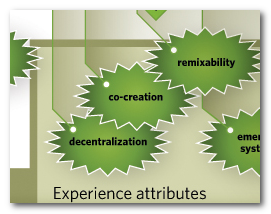
  • Experience attributes: de-centralization, co-creation, remixability, and emergent systems. Again, in Brandon’s words: “By blurring the lines that traditionally delineate supplier, vendor, and customer, these services have pioneered new value streams that can output new types of offerings, harness new efficiencies, and produce higher levels of continuous innovation.”

A quick analysis showed that the focus should indeed be on these experience attributes: the foundations were there, the basic system and processes work, things are happening. But they need to accelerate, explode, go viral. It still wasn’t hard to distinguish supplier, vendor, and customer in the current setup. We all could see new ways to offer new types of value to all stakeholders, but it was time to deliver, and the experience attributes nicely mapped onto dreams, visions, and ideas to move forward.

So with all the technical development just starting, and only some five months left to show concrete, measurable results, targets were mainly defined in terms of those experience attributes:

  • Get at least a couple of formalised partnerships to decentralize and scale up major parts of the organisational processes.
  • Get content in from a few dozen external sources, to remix with the user-generated content already there.
  • Provide new website tools to transform all of that content into compelling stories.
  • Provide new ways for people to share their experiences with their peers and promote the platform, and see them use those.
  • Double the overall amount of page views this way (ay, is this a web 1.0 metric slipping in after all?)

Ambitious goals, but more important: not just hoping on technical wizz-bang to solve things. Developing partnerships and compelling stories is far more a process and collaboration issue (and by far not easy to accomplish in half a year either, but work was already further on the way here). And if nothing else, burning some cash on advertising will provide a reasonably predictable growth of page views if needed — although I’m not supposed to take such a cynical view on these things (yet).