Skip to content

Work in progress

Learning Workshop: what’s next in open data & IATI publishing?

workshop-img.jpg

Publishing data in the IATI format can help organisations and their stakeholders get a better grip on the quality of their information and on their impact. Organisations in a Strategic Partnership with the Dutch Ministry of Foreign Affairs had to publish their first data sets before May 1st.

How did the process go, and what insights and learning points did it bring?

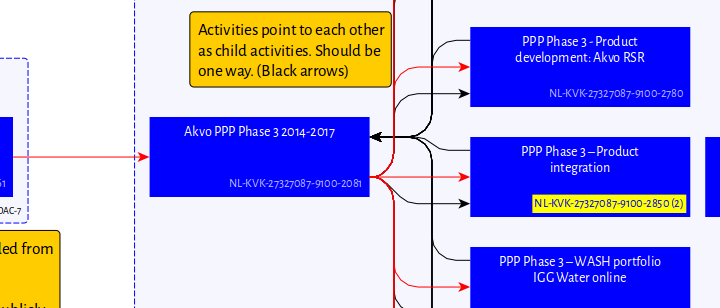
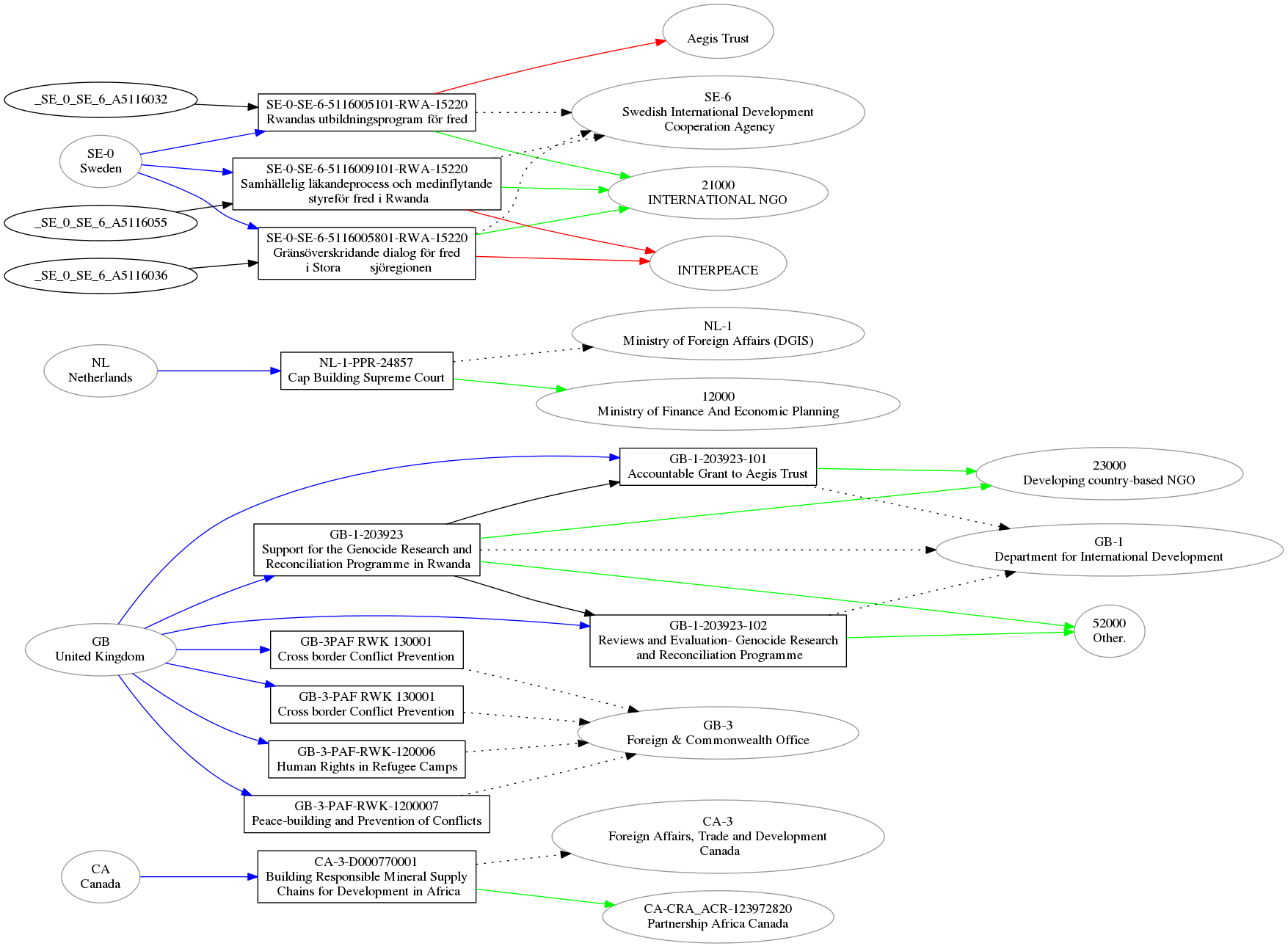
Examining structures in IATI

structure.png

Dozens of new organisations are getting ready to publish IATI data: the Dutch Ministry of Foreign Affairs made it a requirement for the grantees in the strategic partnerships programme on lobby and advocacy that started this year.

The Ministry has published their guidelines on how to create a useful IATI data set, and part of those guidelines (chapter 3) is an overview of how to represent the structure of funding and activities.

I’m helping organisations get their data in order, and so I was looking for an easy way to see the structure of activities in their data. Browsing through XML data only gets you so far…

Cooking with IATI data

cooking.jpg

Imagine: you’ve produced your first data file using the IATI Standard: your organisation’s activities, partner organisations, budgets and results are neatly represented in an XML file. But before you publish that file, you’d like to show it to your team and colleagues and get feedback. XML will not get them very excited.

Can you IATI that for me? (1)

The IATI Standard lets you publish information on your organisation’s activities and money flows. But how exactly would you write something in IATI? That doesn’t always seem obvious, and certainly not for someone new to the XML standard.

This is the first of a series of sketches of situations that I encounter (or envision), with the question: can you #IATI that for me? We’ll start of simple.
iati1.jpg

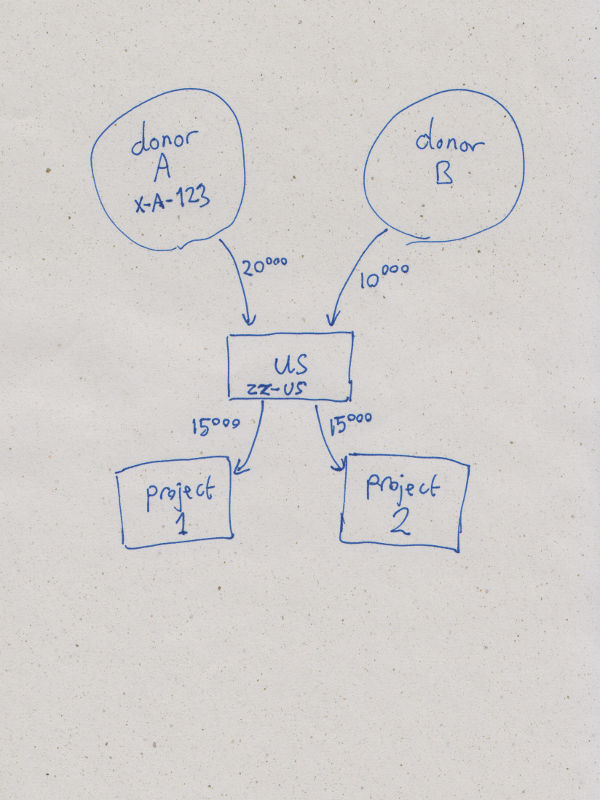
Our organisation, called Us, is going to publish data in IATI. We found out that our organisation identifier is  zz-us. (Not quite as we’d like to see, but the quiz is not about organisation identifiers.)

  • We receive funding from Donor A. They will contribute €20,000  to us. They publish IATI data too, and we found the IATI activity identifier for their grant to us in their file: X-A-123.
  • We also receive funding from Donor B. They will contribute €10,000 to our work this year.
  • We run two projects, Project 1 and  Project 2, each with a budget of €15,000.

Some questions:

  1. How do we indicate the budgets from our donors for our work?
  2. If we actually receive the money (€20,000) from donor A on, say, April 1st, how can we add that to our data?

Feel free to make up more information if you need it. Post your solutions as comments below. They’ll be kept hidden for the first few days, but then will be published for further discussion.

Do we all agree? Do we have different approaches? Is there a right or wrong way of doing it?

The epiphany of “open” and IATI

open.png

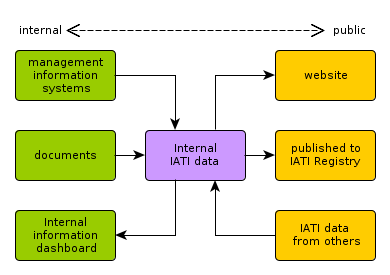
The IATI standard is meant to make it easier to exchange and compare information about activities and funding flows in development aid worldwide. But it can be useful within a (network of) organisations as well, even if you don’t feel ready to share that data with the rest of the world (yet).

Large organisations are starting to see the benefits: adapt your internal project management system so that it contains the necessary information in the right format, then export it to IATI data from there.

You then have an internal, vendor-independent format for your data, and have a choice of tools to put that data to use.

New publication: business intelligence in the aid sector

Announing a new publication: “An Information Platform for Business Intelligence in the Aid Sector based on Open Data and Documents; Integrated Access to structured and unstructured data using the document-oriented database CouchDB”, by Michiel Kuijper.

map-africa.png

Earlier this year, I was approached by Michiel Kuijper, who was working on his Bachelor degree at the Amsterdam University of Applied Sciences, and was looking for a project to combine Business Intelligence and text mining. Together, we started exploring how to apply this in the development aid sector.

A protocol for IATI implementation by CSOs: your comments, please!

../../../../assets/posts/iati-logo-name.png

The International Aid Transparency Initiative (IATI) provides a standard to publish information on aid activities, and is intended to be used by (and useful for) all actors in development aid.

Interest is definitely growing and several organisations are investigating how to implement the standard. In several countries, national platforms of civil society organisations (CSOs) are engaging in discussions with their respective Ministries how to encourage and support implementation of IATI by CSOs. In the UK, DFID is even making IATI-compliant publication of data a condition for funding. Implementing IATI brings to the surface various issues that need to be addressed, some specific for CSOs.

Within IATI, a dedicated informal working group is discussing these implications for CSOs. This CSO Working Group has produced a Background Paper, attempting to provide a comprehensive overview of such issues, and to work towards ways forward.

What are the effects of open development?

At “Open Data for Development Camp” in Amsterdam, Marijn Rijken of the Dutch research institute TNO presented on “open data opportunities in development”. Together, we’re now drafting a research proposal to gather answers on pertinent questions around open data in development: “What are the social, organizational, technological, financial and legal effects of open development?”. It’s part of our efforts to build network as the basis for a Dutch knowledge platform.

../06/ofc-ideas.png

TNO has done similar sector-wide research around open data in other sectors, and would like to take the existing research in this area a step forward. AidInfo published a cost-benefit analysis on open data, and a framework for this. The Transparency and Accountability Initiative recently published a report on introducing open data in middle income and developing countries. And we also like to include “effective use” and impacts on e.g. privacy and security, and a possible “data divide”.

We plan to look at existing literature and research, sketch a vision on what “open development in 2020” could look like, and provide a framework for a social cost-benefit analysis, and the ground work for a road map to help organisations embrace open data and “do it right” (e.g. critical success factors, activating crucial stakeholders and infomediaries).

Of course we like to hear of other research projects with recent publications or currently underway.